
This project is about more than just solar panels. Bristol Energy Cooperative will fund & operate the solar farm, making this a community energy project. This makes it part of a broader movement of renewable energy projects which:
-
Empower local communities
-
Are ethical and sustainable
-
Support the local economy
-
Address fuel poverty and inequalities
-
Fund local organisations
Bristol Energy Cooperative is a not-for-profit organisation, so all revenue from the project will support our mission to reduce carbon emissions and empower local communities. We are extremely proud to have supported a wide range of amazing local organisations through our community grant fund, such as:
-
South Gloucestershire CAB - energy advice for vulnerable people in South Glos.
-
Pretoria Road Allotment Society - water harvesting equipment.
-
Re:Work - advice for people struggling with energy bills.
-
Empowering Futures - sustainability programme for Disabled children.
This solar farm will be no exception - we estimate it will generate around £560,000 in community benefit payments over the next 40 years! Half of this will be directed to support GWAAC’s critical care services, with the remainder available for community benefit more widely.
We intend to run a community share raise for the project - this will be an opportunity to join Bristol Energy Cooperative and become a co-owner of the solar farm. The share raise will be open to anyone with a minimum investment of £100. The target interest rate has not yet been determined, however we are pleased to say that there will be a slightly higher rate for those who live in close proximity to the site. To receive updates, please sign up to our newsletter.
COMMUNITY BENEFITS

THE 5MW SOLAR PV
DEVELOPMENT PROPOSAL
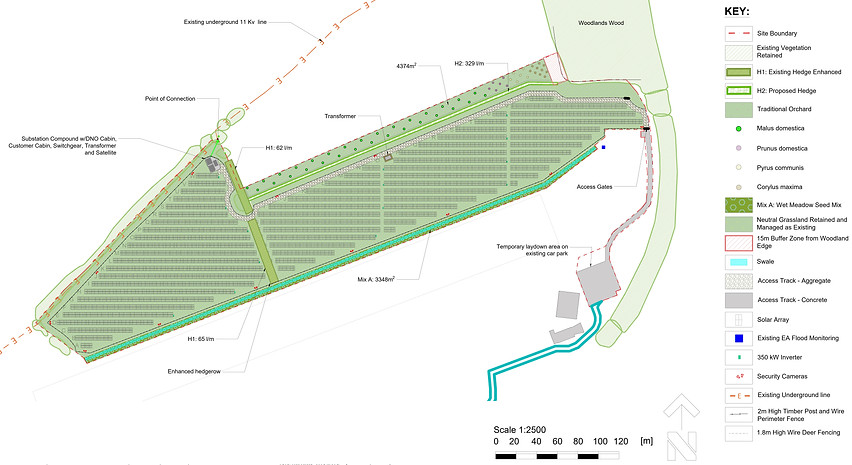
Our proposal is for a small solar farm in the two fields just north of the airbase.
We have designed the layout to balance functionality with environmental sensitivity and visual screening, in keeping with the surrounding landscape.
The panels have been located only in areas which are south-facing or largely screened by trees and hedgerows. Likewise, the electrical compound is tucked away in a corner of the site, screened by vegetation. The solar panels will be black, mounted in rows facing south, with a height of around 3 metres.
The grassland between rows and around the array will be managed to provide benefits for wildlife.
Along the brow of the hill, a large area has been reserved for biodiversity improvements. This will include around 350 metres of new species-rich hedgerow, and a large area devoted to improved grassland habitat.
The access track will mostly be crushed stone, however the section near the airbase will be tarmac due to the downdraft created by helicopters. The perimeter fence will be located to the south of the new hedgerow, helping to retain a more natural landscape when viewed from the north.
DESIGN
ECOLOGY
This project includes a number of improvements to support wildlife, which will result in a net positive outcome for biodiversity at the local scale. These measures are designed to enhance ecological function, habitat quality and landscape connectivity across the site as well as capture carbon. This will include:
-
Around 330 metres of new species-rich hedgerow managed following best practice to serve wildlife. Hedgerows provide essential refuge for wildlife like birds, insects and small mammals, and also help reduce flooding.
-
A large area devoted to grassland managed for biodiversity, including seed planting and grazing. Meadows are great for insects and birds.
-
The planting of native fruit trees to provide food for pollinators and birds.
The project will deliver biodiversity gains of at least 10% across habitat areas and more than 40% for hedgerows. These improvements will be managed carefully and monitored by ecologists, throughout the 40 year project lifetime.